
A model for personal change

A Model for Personal Change
In today’s fast-paced and constantly evolving workplace, the ability to adapt, grow and support others through change is now a defining capability of effective managers and leaders. While many training and coaching approaches focus on behaviours or performance outcomes, deeper and more sustainable change often requires a more structured understanding of how people think, believe and identify themselves.
One particularly powerful framework for enabling this deeper transformation is the model of Neurological Levels, developed by Robert Dilts. This model provides a practical lens through which managers, trainers and coaches can diagnose challenges, guide development conversations and support meaningful personal change.
Background: Robert Dilts and his contribution
Robert Dilts is one of the most influential figures in the field of Neuro-Linguistic Programming (NLP). Building on the foundational work of Richard Bandler and John Grinder, Dilts expanded NLP into areas such as leadership, belief systems and systemic thinking.
His work on Neurological Levels (sometimes referred to as Logical Levels) was inspired in part by anthropologist Gregory Bateson’s theories on learning and communication. Dilts translated these ideas into a practical hierarchy that helps explain how different aspects of human experience interact.
The result is a model that is widely used in coaching, leadership development, psychotherapy and organisational change. Its enduring appeal lies in its simplicity, clarity and immediate applicability.
What are Neurological Levels?
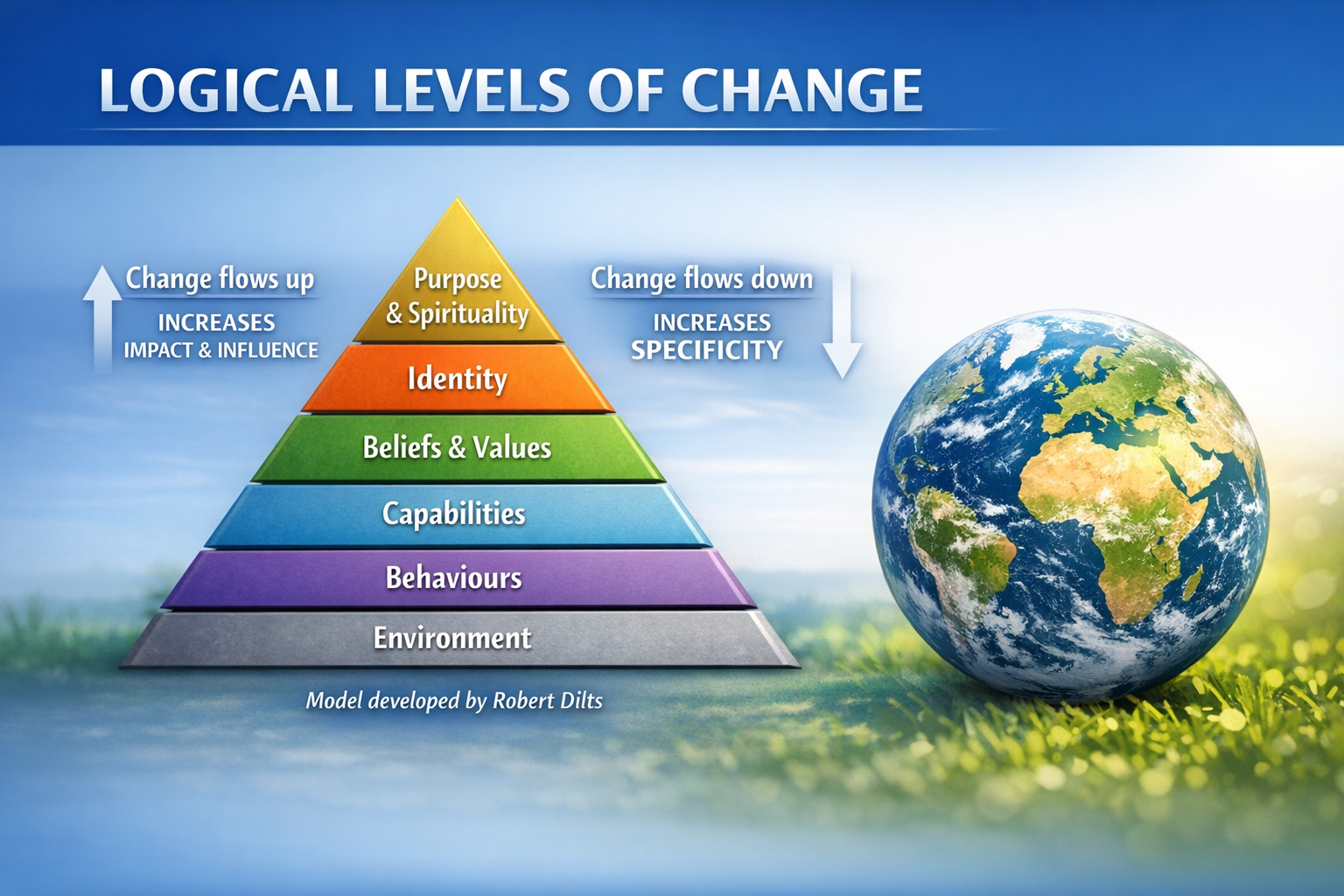
At its core, the Neurological Levels model proposes that human experience operates across a hierarchy of levels. Each level influences the one below it and is influenced by the one above it. When there is alignment across levels, people experience clarity and effectiveness. When there is misalignment, confusion, frustration or stagnation often occurs.
The six levels are:
1 Environment - Where and when things happen
2 Behaviour - What a person does
3 Capabilities (Skills) - How a person does things
4 Beliefs and Values - Why a person does things
5 Identity - Who a person believes they are
6 Purpose (or Spirituality) - For whom or for what larger system
Let’s explore each level in more detail.
Understanding the Levels
Environment: the context
This is the most external level. It includes the physical surroundings, workplace conditions, colleagues, tools, and constraints.
Coaching questions to use can be:
- Where is this happening?
- Who else is involved?
- What external factors are influencing the situation?
Workplace example: A team member struggles with productivity because they work in a noisy, interruption-heavy office.
Behaviour: actions and results
Behaviour refers to observable actions—what someone says or does.
Coaching questions to use can be:
- What are you doing (or not doing)?
- What specifically happens in this situation?
Workplace example: A team member consistently misses deadlines or avoids contributing in meetings.
Capabilities: skills and strategies
This level relates to competencies, knowledge, and the strategies people use to perform tasks.
Coaching questions to use can be:
- How do you approach this?
- What skills are required here?
- What strategies have you tried?
Workplace example: A team member lacks time management skills or doesn’t know how to prioritise effectively.
Beliefs and Values – Motivation and Meaning
Beliefs shape what people think is possible or appropriate, while values determine what is important to them.
Coaching questions to use can be:
- What do you believe about this situation?
- Why is this important to you?
- What assumptions might be influencing you?
Workplace example: A team member believes “I’m not good at presenting” or values perfection so highly that delivery of a task is delayed.
Identity – Self-image
Identity reflects how individuals see themselves. It answers the question, “Who am I?”
Coaching questions to use can be:
- Who are you in this situation?
- How do you see yourself as a professional?
Workplace example: A manager sees themselves as “not a natural leader,” which limits their confidence and decision-making.
Purpose – The bigger picture
This is the highest level and relates to meaning, contribution, and connection to something larger than oneself.
Coaching questions to can be:
- What larger purpose does this serve?
- Who else benefits from your success?
Workplace example: A team member feels disconnected from organisational goals and lacks a sense of meaning in their work.
How the levels interact
One of the most important principles of the model is this:
Change at a higher level creates change at lower levels, but not necessarily the other way around.
For example:
- Changing someone’s environment (e.g. moving desks) may not improve performance if limiting beliefs remain.
- However, shifting a person’s identity (“I am a capable leader”) can influence beliefs, skills, behaviours, and ultimately results.
This insight is crucial when coaching others. Many workplace interventions fail because they target the wrong level.
Using Neurological Levels when coaching others
Diagnosing the level of the problem
A common coaching mistake is to assume that all issues are behavioural or skill based. In reality, many challenges stem from deeper levels.
Example: A team member avoids presenting.
- Behaviour level: They don’t speak up
- Capability level: They lack presentation skills
- Belief level: “I’ll embarrass myself”
- Identity level: “I’m not a confident communicator”
If you only address skills (capability), the problem may persist because the root cause lies in beliefs or identity.
Coaching tip Listen carefully to language. Words like “I can’t,” “I’m not,” or “I always” often signal deeper levels.
Asking level-specific questions
Effective coaching involves asking questions that target the appropriate level.
- If the issue is environmental, explore context and resources
- If it’s behavioural, focus on actions and accountability
- If it’s capability-based, develop skills and strategies
- If it’s belief-driven, challenge assumptions
- If it’s about identity, reframe self-perception
- If it’s about purpose, reconnect to meaning
Examples coaching questions to use are:
- What’s happening? (behaviour)
- How are you approaching it? (capabilities)
- What do you believe about this? (beliefs)
- Who are you when you’re at your best? (identity)
Creating alignment across Levels
High performance occurs when all levels are aligned.
Example of alignment:
- Environment: Supportive team
- Behaviour: Proactive contribution
- Capabilities: Strong communication skills
- Beliefs: “My input adds value”
- Identity: “I am a confident professional”
- Purpose: “I contribute to team success”
Coaching role: Help individuals identify and resolve misalignments.
Supporting sustainable change
Short-term fixes often occur at lower levels (environment, behaviour), but lasting change requires working at higher levels.
Practical approach to follows is to:
- Identify the presenting issue
- Explore deeper levels through questioning
- Challenge limiting beliefs
- Reinforce empowering identity statements
- Connect actions to purpose
Using the Neurological Levels model in real conversations
Here’s a simple structure you can use in a coaching conversation:
Step 1: Start with the issue
“What’s the challenge you’re facing?”
Step 2: Explore levels upward
“What have you been doing?” (behaviour)
“How are you approaching it?” (capabilities)
“What do you believe about this?” (beliefs)
“How does this relate to how you see yourself?” (identity)
Step 3: Reframe and build
“What would you need to believe instead?”
“Who do you need to be to succeed here?”
“What’s the bigger impact if you get this right?”
Step 4: Return to action
“What will you do differently?”
Practical workplace applications
The Neurological Levels model is highly versatile. Here are some common use examples:
Performance improvement
Identify whether performance gaps are due to skills, beliefs, or identity—not just behaviour.
Leadership development
Support emerging leaders in shifting identity from “individual contributor” to “leader.”
Change management
Help employees connect organisational change to personal purpose and values.
Confidence building
Work at the belief and identity levels to create lasting confidence.
Team coaching
Identify shared values and purpose to improve alignment and collaboration.
Common pitfalls to avoid
While powerful, the model must be used thoughtfully:
Overcomplicating conversations - keep your language simple and natural
Jumping to conclusions - let the person you are coaching reveal the level
Ignoring lower levels - practical barriers still matter
Forcing “deep” conversations - not every issue requires identity work
Balance is key. The model is a guide, not a rigid formula.
Summary:
Robert Dilts’ Neurological Levels model offers a structured yet flexible way to understand human behaviour and facilitate meaningful change. For managers, trainers and coaches, it provides a helpful roadmap for navigating conversations that go beyond surface-level fixes.
By recognising that challenges can exist at different levels, and by addressing the right level, you can help colleagues and team members unlock deeper insights, overcome barriers and achieve more sustainable growth.
Ultimately, the model reminds us that true change is not just about doing something different. Instead, it’s about thinking differently, believing differently and sometimes even becoming someone new.
And that is where real transformation begins.
Paul Beesley
Director & Senior Consultant, Beyond Theory
Related blog articles:
Become a coach rather than a critic
What is the best coaching question ever?
Empathy – not tea and sympathy